Great piece by the BBC on the die off of honeybees worldwide. When trying to get to the bottom of what is going on I particularly like the analogy of going to the pharmacist and being asked what other medication you are taking to find out if there could be any negative interactions. I think this approach gets to the crux of colony collapse disorder. It is not one single thing in the environment but several working in congress and becoming toxic. Unfortunately this gives cover to the pesticide and GMO manufacturers since by themselves they are not directly toxic to honeybees.

Friday, March 4, 2011
Tuesday, March 1, 2011
Links on Food and Bees
Victoria farmer working to bring back buzz of native bees
Alarmed at honeybee colony losses that reached 80 to 100 per cent last spring on Vancouver Island, a Victoria farmer is abuzz over a program she says will boost native bee populations that could replace the threatened honeybee.
Working with the Victoria-based land trust, The Land Conservancy, as an agricultural program assistant, Nathalie Chambers is leading the just-launched Pollinator Enhancement Program. The provincewide plan aims to improve conditions for native bees so that farmers are not as dependent on the honeybee, the dominant pollinator, originating in the Mediterranean area and brought to B.C. in 1858.
US food prices could surpass 2008 levels, says USDA
US food prices could surpass those seen during the 2008 food price crisis this year, as higher commodity and energy prices cause food makers to pass on costs, according to the US Department of Agriculture (USDA).
The USDA predicted late last year that food prices would rise during 2011, and in recent weeks several major food manufacturers have said they intend to raise prices on the back of stronger commodity costs. The USDA had been saying since July that food price inflation – after dropping to its lowest rate in 18 years – would accelerate during 2011, by 2 to 3 percent. But it is only in the last week that the agency revised its forecast, saying that it predicts the Consumer Price Index (CPI) to rise by 3 to 4 percent during the year.
Bumblebees' disappearance 'alarming'
Four species see 96-per-cent decline
- Four previously abundant species of bumblebee are close to disappearing in the United States, researchers reported yesterday in a study confirming that the agriculturally important bees are being affected worldwide.
They found a 96-per-cent decline in the numbers of the four species and said their range had shrunk by as much as 87 per cent. As with honeybees, a pathogen is involved, but the researchers also found evidence of inbreeding caused by habitat loss.
"We provide incontrovertible evidence that multiple Bombus species have experienced sharp population declines at the national level," researchers reported in the Proceedings of the National Academy of Sciences, calling the findings "alarming."
"These are one of the most important pollinators of native plants," said Sydney Cameron of the University of Illinois, who led the study.


Saturday, February 26, 2011
Improving honeybee populations?
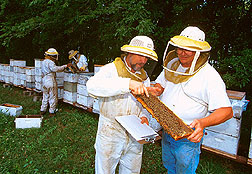
I came accross this article and still haven't been able to find the USDA survey release associated with it.
The number of honey-producing bee
colonies in the U.S. rose 7.4 percent last year
and honey production was up 20 percent,
the Department of Agriculture said.
About 2.684 million colonies were reported
by beekeepers with five or more hives in
2010, the USDA said Friday in a report.
Honey production rose to 65.5 pounds per
colony, up 12 percent from 2009, with
overall output at 176 million pounds. The
average price at the private and retail levels
was $1.603 a pound, an all-time high and up
8.8 percent from the previous record last
year, the USDA said.
If this is the full story this is very good news. I would like to find the full survey to see if it mentions the size of colonies. Beekeepers could be maintaining more hives that are smaller colonies by splitting colonies into two hives as population rises in the summer. Also honey prices have dramatically increased in the last few years, so it is possible that more beekeepers are focusing more on honey production than just making their money on pollination. Bee colonies were still being flown in from Australia last year for pollination, which tells me along with continued high pollination rates that farmers are still struggling to get bees for pollination.
Hopefully we are turning the corner or at least things are getting less worse. But with many surveys like this the devil is in the details. While colonies may be improving and honey production is ramping up, pollination could still be in peril. I would like to get the full story.
Friday, February 25, 2011
Permaculture and Polyculture.
Paul gives a good run down on how interconnected plants can be in agriculture. Also he shows the pitfalls of monoculture where only one type of crop is grown in an area.
Agriculture measured in barrels not bushels.

With the recent run up in oil it is particularly timely to look at the impact of higher oil prices on agriculture. Long term our current structure of industrial large scale agriculture is not sustainable to keep prices low on commodity crops. Since WWII production has been increasing per acre quite dramatically. Pesticides, cheap synthetic fertilizers and a low cost transportation system boosted yields at the same time crop prices moderated even as populations globally soared.
As you can see the large gains in agricultural yields has been on the back of an expanding oil supply and better technology. While I am not in the camp that we are running out of oil, we are running out of "cheap" oil namely light sweet crude which is easier and cheaper to refine than heavier varieties. Also many of the land based oil fields are maturing making oil more costly to extract in new areas such as off shore.(ratio of corn out/energy in): Ratio in 1945 = 3.5Between 1910 and 1983, corn yields in the US increased by 346% (on a per area basis), which the energy inputs increased by 810%, also on a per area basis!
Ratio in 1983 = 2.5
That is, we are putting more and more fossil fuel energy into production for a given level of output! Viewed slightly differently, we're not getting as much more corn out as we are putting extra energy in; the efficiency ratio is worsening over time!
Wikipedia:
Switching to natural gas could help blunt the impact of an oil price spike. New natural gas fields are being found and new technology has greatly increased recovery rates. Natural gas is cleaner than oil but we are still looking at supply constraints to keep up with the current trajectory of food production needed for population growth. Natural gas is used extensively in ammonia fertilizer production.Ammonia production depends on plentiful supplies of natural gas, a finite resource, to provide the hydrogen. Due to ammonia's critical role in intensive agriculture and other processes, sustainable production is desirable. This is possible by using renewable energy to generate hydrogen by electrolysis of water. This would be straightforward in a hydrogen economy by diverting some hydrogen production from fuel to feedstock use. For example, in 2002, Iceland produced 2,000 tons of hydrogen gas by electrolysis, using excess electricity production from its hydroelectric plants, primarily for the production of ammonia for fertilizer.[3] The Vemork hydroelectric plant in Norway used its surplus electricity output to generate renewable ammonia from 1911 to 1971.[4] In practice, natural gas will remain the major source of hydrogen for ammonia production as long as it is cheapest.As you can see keeping ammonia inexpensive and plentiful will be difficult. If we look to electrolysis for hydrogen production we need to produce more clean electricity. Cost of new energy for electricity will become more expensive as fossil fuel prices continue to rise. My feeling is that until alternative energy picks up the slack for higher oil prices, natural gas will step in as an acceptable alternative. Increased natural gas demand will keep fertilizer prices increasing.
What are the alternatives. Swing the pendulum back towards more small farms, less monoculture and more local production. It may cost more to grow a tomato in the north than in Mexico but the increasing price of transportation will keep smaller local farms economically viable. Much more study must be done to improve a poly-culture approach to agriculture. What crops grow best together? What can be used on the farm to provide its own fertilizer?
I am very optimistic on agriculture and farming in the long term. It will be a struggle to deal with higher fossil fuel cost but eventually we will be more sustainable and less dependent on fossil fuels.
Thursday, February 24, 2011
More on building your own top bar hive
Here are several videos on building your own top bar hive. Top bar hives help prevent mites that spread diseases. Top bar hives are also an affordable alternative to buying a more widely used langsroth hive. Here are some previous posts on top bar plans here and here.
How To Build A Kenya Top Bar Hive - Part 1 - Top Bars from DavesBees on Vimeo.
How To Build A KTBH - Part 2 - Follower Boards from DavesBees on Vimeo.
How To build A Kenya Top Bar Hive - Part 3 - Legs And Hive Ends from DavesBees on Vimeo.
How To Build A Kenya Top Bar Hive – Part 4 – Drill Legs And Attach Ends from DavesBees on Vimeo.
How To Build A Kenya Top Bar Hive - Part 5 - Finish Hive And Attach Legs from DavesBees on Vimeo.
How To Build A Kenya Top Bar Hive - Part 6 - The Lid from DavesBees on Vimeo.
Sunday, February 20, 2011
More Top Bar Hive Plans
Here is another set of plans to build your own top bar hive. Top bar hives do a good job replicating a hive design closer to what is in nature like a hollow log. The advantage to the bees drawing out all of their own comb is that it helps prevent mites. Mites have a hard time climbing back on to the combs and bees with the much larger gap below than commercial hives. Mites carry viruses and disease that spreads through the hive. Minimize mites and you will have a healthier hive all around. You can see a previous post of plans here.
Visual Step-By-step Construction of a Kenyan Top Bar Hive
Visual Step-By-step Construction of a Kenyan Top Bar Hive
Commercial Pollination going forward.


As agriculture became more specialized and more reliant on economies of scale to production costs low, bees were moved around the country to pollinate one crop after another as they bloomed. This is done on a large scale with bees only having one type of blossom to forage for weeks at a time. Until the last hundred years bees were never used like this, transported on semi-trucks to one field or orchard after another. It boosts crop yields but bees never evolved to be dependent upon a monoculture, they aren't designed for the industrial agricultural paradigm.
We shouldn't be surprised of the large bee losses lately inclusively known as CCD or colony collapse disorder. Beekeepers that don't follow the blooming of crops around the country aren't having the same problems. Comparatively the losses of small natural and organic beekeepers are minimal. As an analogy imagine that you are a traveling salesman going to a new city each month but the catch is that you can only eat one type of food breakfast, lunch and dinner. Bacon one month, pepperoni pizza the next, plain rice the next and dry salads the next. After a season like this you would probably be malnourished, even though if you mixed it all you would be fine. Same things with the bees monoculture and traveling are making their immune systems diminished and more susceptible to disease.
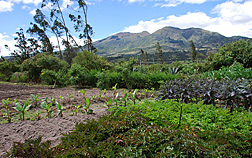
Some alternatives are:
Set aside an easement on a farm for native and commercial pollinators to forage. This allows more diversity in pollinators for better pollination. Some pollinators do better in cool or wet weather than honeybees allow even better crop yield. More forage for bees will allow pollinators to be kept in the same area year round.
Vary the crops being grown, much like crop rotation diversity of crops will cut down on one single pest that thrives in an environment of their favorite plant to vex. Bees can fly up to 3 miles to forage so large farms can grow several tracts of crops giving some diversity to pollinators.
Research. More research needs to be done in finding better farming techniques that look at farming as a series of systems that all work together to be more self-sufficient. Growing crops to help fertilize others, growing crops to help pollinate others and growing crops to help conserve water in the field.
The problem with this type of research can be summed up in one phrase "follow the money". There will never be the economic incentive to do in-depth research into dynamic farming as producing the next block buster billion dollar GMO crop or pesticide. The financial incentive is just not their in research and more and more funding at the university level is coming from the big chemical and modified crop companies. Companies help fund research that they can use while other funding gets cut due to budget constraints.
Eventually a few enterprising individuals will show success and profit with a fully integrated permaculture method of farming. This will be about the same time oil becomes so expensive that conventional agriculture will be looking to alternatives to petroleum based fertilizers and long distances transport.
Friday, February 18, 2011
Honey bee collateral damage from Clothianidin "poncho" acceptable to EPA

A few months ago a memo leaked from the EPA (not a Wikileak counter to some claims) exposes clothianidin as toxic to honey bees. Clothianidin produced by Bayer crop sciences as "poncho" is in the nicotine family of pesticides. Poncho has been banned in several European countries so far, Germany, France, Italy and Slovenia. It is used on corn, canola, beets, wheat, sunflowers and Soy.
Neonicotinoid family pesticides work by being taken up into the plant and making it poisonous to 'pests" and other insects that happen to be there. Poncho has been found in the pollen and nectar of plants.
From the label recomendations :
This compound is toxic to birds and mammals. Treated clothianidin seeds exposed on soilsurface may be hazardous to birds and mammals. Cover or collect clothianidin seeds spilledduring loading. This compound is toxic to honey bees. The persistence of residues and potential residual toxicityof Clothianidin in nectar and pollen suggests the possibility of chronic toxic risk to honey beelarvae and the eventual instability of the hiveAnd from a PhD entomologist
According to James Frazier, PhD., professor of entomology at Penn State’s College of Agricultural Sciences, "Among the neonicotinoids, clothianidin is among those most toxic for honey bees; and this combined with its systemic movement in plants has produced a troubling mix of scientific results pointing to its potential risk for honey bees through current agricultural practices. Our own research indicates that systemic pesticides occur in pollen and nectar in much greater quantities than has been previously thought, and that interactions among pesticides occurs often and should be of wide concern." Dr. Frazier said that the most prudent course of action would be to take the pesticide off the market while the flawed study is being redone.The EPA knows all the evidence and the toxicity but it still stays on the market. One has to wonder who is the EPA working for. No wonder bees are showing much higher losses in big agricultural areas. Eventually the fall of bee populations will catch up to the point that farmers won't worry so much about increasing yield with chemical pesticides if they don't have pollinators for their crops.
The full EPA memo is here.
Subscribe to:
Posts (Atom)