
Showing posts with label hives. Show all posts
Showing posts with label hives. Show all posts
Sunday, June 10, 2012
DIY Top Bar Hive; Recycled Barrel
Created with Admarket's flickrSLiDR.
This is a brilliant idea to repurpose an old food grade barrel. This makes two top bar hives. Full Directions can be found here: http://www.velacreations.com/honeycow.html


Tuesday, May 8, 2012
One Million People Sign Emergency Petition to Ban Bee-Killing Nicotine Pesticide Illegally Registered in Us
Word is getting out there of collateral damage from nicotine based pesticides. The ground swell of attention is surprising considering overall knowledge of our food supply here in America by the average citizen.
A remarkable emergency petition with over one million signatures has been submitted to the USEPA requesting the withdrawal of the pesticide clothianidin - a nicotine-based systemic pesticide widely used on corn/maize. Multiple activist organizations participated, lead by major US beekeepers.
The basis of the petition is that the USEPA's legal requirements for the demonstrated safety of clothianidin were never proven - and subsequent findings have shown its damages - violating the US law FIFRA, which governs the registration process for pesticides.
A coalition of beekeepers and activists gained over one million signatures on this petition, that walks step-by-step through the reasoning behind the proposed determination of the clothianidin registration's illegality - used as the basis for the withdrawal request.
This is fantastic.
http://pierreterre.com/blog/bee-killing-nicotine-pesticide-illegally-registered-us-one-million-sign-petitionPlease download the complete original emergency petition linked here (English version):
http://www.beyondpesticides.org/pollinators/CFS-Clothianidin-Petition-3-20-12.pdf
Tuesday, April 17, 2012
Sunday, June 5, 2011

Saturday, February 26, 2011
Improving honeybee populations?
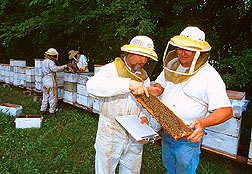
I came accross this article and still haven't been able to find the USDA survey release associated with it.
The number of honey-producing bee
colonies in the U.S. rose 7.4 percent last year
and honey production was up 20 percent,
the Department of Agriculture said.
About 2.684 million colonies were reported
by beekeepers with five or more hives in
2010, the USDA said Friday in a report.
Honey production rose to 65.5 pounds per
colony, up 12 percent from 2009, with
overall output at 176 million pounds. The
average price at the private and retail levels
was $1.603 a pound, an all-time high and up
8.8 percent from the previous record last
year, the USDA said.
If this is the full story this is very good news. I would like to find the full survey to see if it mentions the size of colonies. Beekeepers could be maintaining more hives that are smaller colonies by splitting colonies into two hives as population rises in the summer. Also honey prices have dramatically increased in the last few years, so it is possible that more beekeepers are focusing more on honey production than just making their money on pollination. Bee colonies were still being flown in from Australia last year for pollination, which tells me along with continued high pollination rates that farmers are still struggling to get bees for pollination.
Hopefully we are turning the corner or at least things are getting less worse. But with many surveys like this the devil is in the details. While colonies may be improving and honey production is ramping up, pollination could still be in peril. I would like to get the full story.
Thursday, February 24, 2011
More on building your own top bar hive
Here are several videos on building your own top bar hive. Top bar hives help prevent mites that spread diseases. Top bar hives are also an affordable alternative to buying a more widely used langsroth hive. Here are some previous posts on top bar plans here and here.
How To Build A Kenya Top Bar Hive - Part 1 - Top Bars from DavesBees on Vimeo.
How To Build A KTBH - Part 2 - Follower Boards from DavesBees on Vimeo.
How To build A Kenya Top Bar Hive - Part 3 - Legs And Hive Ends from DavesBees on Vimeo.
How To Build A Kenya Top Bar Hive – Part 4 – Drill Legs And Attach Ends from DavesBees on Vimeo.
How To Build A Kenya Top Bar Hive - Part 5 - Finish Hive And Attach Legs from DavesBees on Vimeo.
How To Build A Kenya Top Bar Hive - Part 6 - The Lid from DavesBees on Vimeo.
How To Build A Kenya Top Bar Hive - Part 1 - Top Bars from DavesBees on Vimeo.
How To Build A KTBH - Part 2 - Follower Boards from DavesBees on Vimeo.
How To build A Kenya Top Bar Hive - Part 3 - Legs And Hive Ends from DavesBees on Vimeo.
How To Build A Kenya Top Bar Hive – Part 4 – Drill Legs And Attach Ends from DavesBees on Vimeo.
How To Build A Kenya Top Bar Hive - Part 5 - Finish Hive And Attach Legs from DavesBees on Vimeo.
How To Build A Kenya Top Bar Hive - Part 6 - The Lid from DavesBees on Vimeo.
Sunday, February 20, 2011
More Top Bar Hive Plans
Here is another set of plans to build your own top bar hive. Top bar hives do a good job replicating a hive design closer to what is in nature like a hollow log. The advantage to the bees drawing out all of their own comb is that it helps prevent mites. Mites have a hard time climbing back on to the combs and bees with the much larger gap below than commercial hives. Mites carry viruses and disease that spreads through the hive. Minimize mites and you will have a healthier hive all around. You can see a previous post of plans here.
Visual Step-By-step Construction of a Kenyan Top Bar Hive
Visual Step-By-step Construction of a Kenyan Top Bar Hive
Friday, February 18, 2011
Honey bee collateral damage from Clothianidin "poncho" acceptable to EPA

A few months ago a memo leaked from the EPA (not a Wikileak counter to some claims) exposes clothianidin as toxic to honey bees. Clothianidin produced by Bayer crop sciences as "poncho" is in the nicotine family of pesticides. Poncho has been banned in several European countries so far, Germany, France, Italy and Slovenia. It is used on corn, canola, beets, wheat, sunflowers and Soy.
Neonicotinoid family pesticides work by being taken up into the plant and making it poisonous to 'pests" and other insects that happen to be there. Poncho has been found in the pollen and nectar of plants.
From the label recomendations :
This compound is toxic to birds and mammals. Treated clothianidin seeds exposed on soilsurface may be hazardous to birds and mammals. Cover or collect clothianidin seeds spilledduring loading. This compound is toxic to honey bees. The persistence of residues and potential residual toxicityof Clothianidin in nectar and pollen suggests the possibility of chronic toxic risk to honey beelarvae and the eventual instability of the hiveAnd from a PhD entomologist
According to James Frazier, PhD., professor of entomology at Penn State’s College of Agricultural Sciences, "Among the neonicotinoids, clothianidin is among those most toxic for honey bees; and this combined with its systemic movement in plants has produced a troubling mix of scientific results pointing to its potential risk for honey bees through current agricultural practices. Our own research indicates that systemic pesticides occur in pollen and nectar in much greater quantities than has been previously thought, and that interactions among pesticides occurs often and should be of wide concern." Dr. Frazier said that the most prudent course of action would be to take the pesticide off the market while the flawed study is being redone.The EPA knows all the evidence and the toxicity but it still stays on the market. One has to wonder who is the EPA working for. No wonder bees are showing much higher losses in big agricultural areas. Eventually the fall of bee populations will catch up to the point that farmers won't worry so much about increasing yield with chemical pesticides if they don't have pollinators for their crops.
The full EPA memo is here.
Wednesday, February 9, 2011
Beehive home tour.
This is great overview of different hive designs as well as options for urban beekeeping. I have plans for a top bar hive here.
Thursday, October 21, 2010
Colony Collapse Disorder prevention turns out to be easy
Common sense explanation of CCD and the problems with commercial beekeeping methods. Probably not dramatic enough to be on the front page of the New York Times.
Friday, August 13, 2010
CCD or SNAFU?
I came across a great video from Penn State on CCD. It seems as the rate of CCD does decline in areas other causes of hive loss begin to become more apparent. Over all back in 1980 America the number of bee colonies had peaked and has been diminishing ever since. Aggravated by more intensive agricultural methods and the introduction of mites the steady decline continues even after you factor out colony collapse disorder. The current rate of winter losses is around 30% still above the more traditional 20%. This becomes more difficult to make up during the summer by splitting hives. When you have 7 of 10 of last years hives you need to be much more focused to build up your bees to get the 3 back out of the 7 left than getting a more normal 2 out of the 8 from last year. Hopefully we can get back to a more normal attrition rate sooner than later.
Friday, July 30, 2010
Ancient Beehives Discovered
 |
| Ancient beehives. Great article on a new discovery of Bible era apiaries from the Jerusalem Post |
'Land of Milk and Honey' it is
Now it's official. The Land of Milk and Honey has lived up to its name. A Hebrew University archeologist has uncovered the oldest known apiary, or beehive colony, in the Middle East. Prof. Amihai Mazar found the beehive colony, dating to the 10th to early 9th centuries BCE, in an archeological excavation this summer in the Beit She'an Valley. The biblical-period beehive colony was discovered in Tel Rehov, which is believed to have been one of the Israelite kingdom's most important cities. Three rows of beehives were found in the apiary, containing more than 30 hives, although the archeologists estimated that the total area may have contained some 100 beehives. Beekeepers and scholars estimated that as much as half a ton of honey could be culled from these hives every year, the university said Monday. The dating of the beehives was done by measuring the decay of the Carbon-14 isotope in organic materials, using grains of wheat found next to the beehives. This grain was dated by a laboratory at Groningen University in the Netherlands to the period between the mid-10th century BCE until the early 9th century BCE, a time period attributed to the reign of King Solomon and the first kings of the northern Kingdom of Israel following the division of the monarchy. Mazar said that these are the first beehives ever discovered at any site from the ancient Middle East. He said that while ceramic vessels that served as beehives were known from the Hellenistic and Roman periods, none were found intact, and beekeeping on an industrial scale such as the apiary at Tel Rehov was hitherto unknown in the archaeological record. Pictorial depictions of apiaries exist from Pharaonic Egypt, showing extraction of honey from stacked cylinders that are very similar to those found at Tel Rehov. The discovery at Tel Rehov indicates that beekeeping and the extraction of bees' honey and honeycomb was a highly developed industry as early as the First Temple period, Mazar said. Israel is referred to as the Land of Milk and Honey in the Bible 16 times, though the term is often thought to refer to the honey-like date fruit. One well known instance of an actual honeycomb being mentioned in the Bible is in I Samuel, where Jonathan tastes honey from a honeycomb during the battle with the Philistines. During the dig, archeologists also uncovered three ceramic storage jars found near the beehives with the inscription "To nmsh." "Nimshi" is known in the Bible as the name of the father and in several verses the grandfather of Israelite King Jehu, the founder of the dynasty that usurped power from the House of Omri (II Kings: 9-12). The archeologists involved in the dig believe that it is possible that the discovery of three inscriptions bearing this name in the same region and dating to the same period indicates that Jehu's family originated from the Beit She'an Valley and possibly even from the large city located at Tel Rehov. The large apiary discovered at the site might have belonged to this illustrious local clan.
Thursday, July 29, 2010
Beehives of the world
 |
| Beehives in China near where the earthquake struck. Hollow logs covered with slate to keep them from the elements. |
 |
| This is the modern type of bee hive used in Cameroon called a Kenyan Top Bar. The other kind is like an artificial hollow log made from bamboo-- kind of like Winnie the Pooh. And all of the bees here are African Killer Bee |
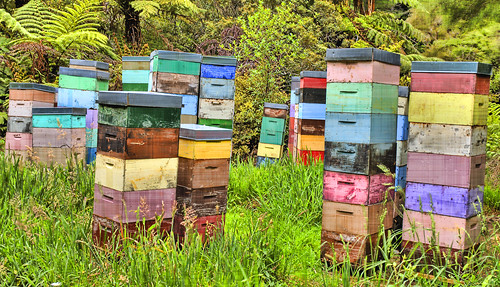 | ||
| Beehives from the north island of New Zealand. |
 | |
| Museum of Folk Architecture and Rural Life. Pyrohiv, Nr Kyiv. Over time historical buildings have been brought here from all over Ukraine to live the communal life of an open-air museum. The space is split into the regions of Ukraine so that the buildings are grouped by geographic origin. The beehives where used as such in the past, disused now. They have been brought from Volyn' a province in Western Ukraine. They are made from the trunks of trees and each one is slightly different; different trees lend themselves to different effects. Some of them are decorated, carved or have thatched rooves. Each trunk would have a section cut out which is used to hollow out the trunk and then the outer piece is refitted as a sort of 'door' into the inside. |
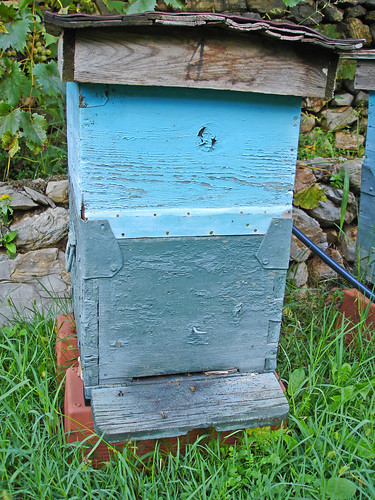 |
| Beehive. |
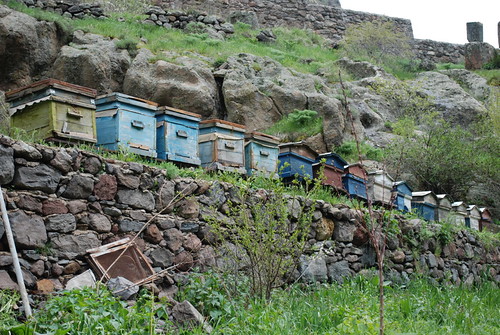 |
Beehives - Geghard Monastery - Armenia |
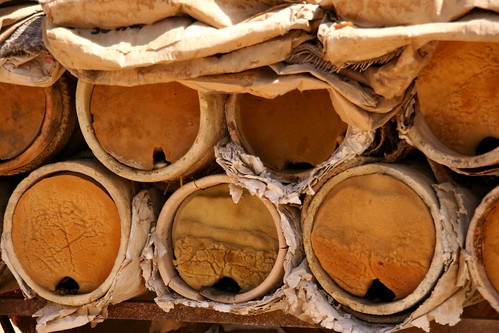 |
| Yemen |
 |
| Siberia. A nice cushion to keep them warm. |
 |
| Mobile beehives in Slovenia. |
 |
| More individually painted hives from Slovenia. Your Beeswax: More Beehives from around the world |

Thursday, July 22, 2010
Subscribe to:
Posts (Atom)