
Thursday, September 16, 2010
Candle making with Martha
I haven't played around making custom silicon molds myself but, silicon is the best way to go making beeswax candles. Silicon molds release the candle easily and allow for it to set up evenly avoiding cracks and voids.
Links:
silicone
http://www.smooth-on.com
beeswax
http://hiveharvest.com


Monday, September 13, 2010
Beekeeping of Yesteryear
 |
| "Uncle" Dan Meyers, of Cades Cove in Great Smoky Mountains National Park, shown with his beehives fashioned from tree trunks. |
 | |
| A woman stands next to a bee hive (also known as bee gums) ca. 1900-1915. The photo's label reads "Bee gums! In the Carolina's. Photo by Margaret W. Morley." North Carolinians have been keeping bees since the 1600s, when settlers brought European honey bees with them. |
 |
| 'Interested Spectators.'' Working among the bees, the older boy shows the effects of a beesting (beneath the eye) received while working among them a short time before. |
 |
| Hiving Bees. Shaking (from branch on which they clustered) in front of hive which they are to occupy. Note the bees in the air as shown against his clothes and the hive. |
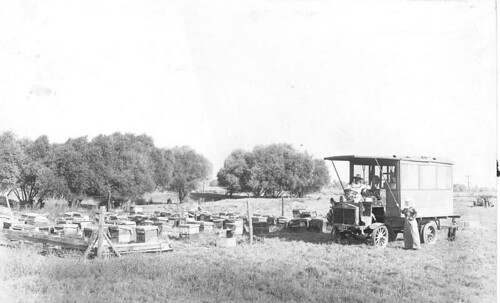 | |||||||||||||||||||||||||||||||||||||||||||||||||
| Old bee yard. |
Friday, September 10, 2010
More Beehives from around the world
 | |
| Sidr honey beehives. This rare honey goes for $200 a Kg or about $100 a lb. |
 |
| A London roof top, notice the camera to watch the bees. |
 |
| Collecting heather honey. |
 |
| Holland circa 1900. |
Wednesday, September 8, 2010
Links: Bees in the News
Bee vaccine for CCD http://www.israel21c.org/technology/bee-colony-vaccine
Improving Honey production with tree imports. http://www.israel21c.org/201009068324/environment/a-bee-story-with-a-difference
German suit concerning pesticide and CCD http://www.docstoc.com/docs/53894497/German-Coalition-Sues-Bayer-Over-Pesticide-Honey-Bee-Deaths
Improving Honey production with tree imports. http://www.israel21c.org/201009068324/environment/a-bee-story-with-a-difference
German suit concerning pesticide and CCD http://www.docstoc.com/docs/53894497/German-Coalition-Sues-Bayer-Over-Pesticide-Honey-Bee-Deaths
Thursday, September 2, 2010
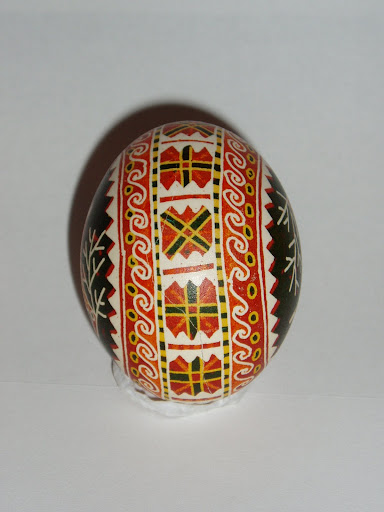
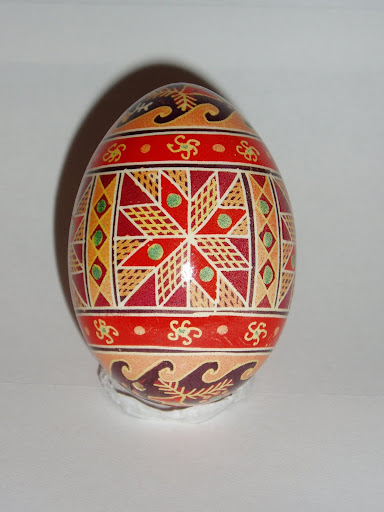
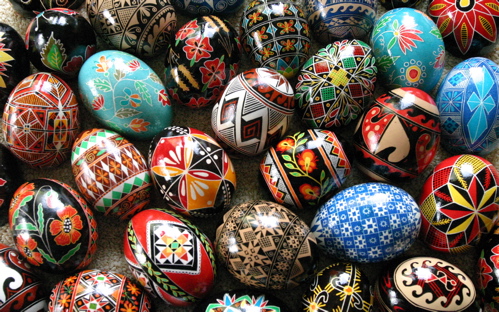
Pysanka
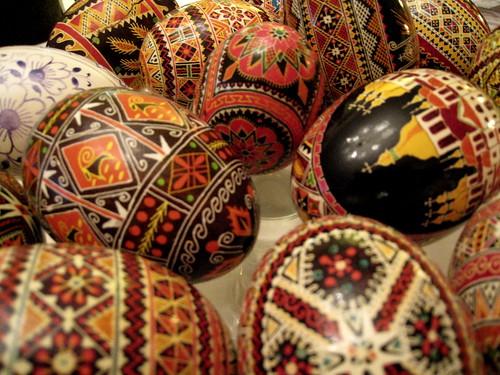
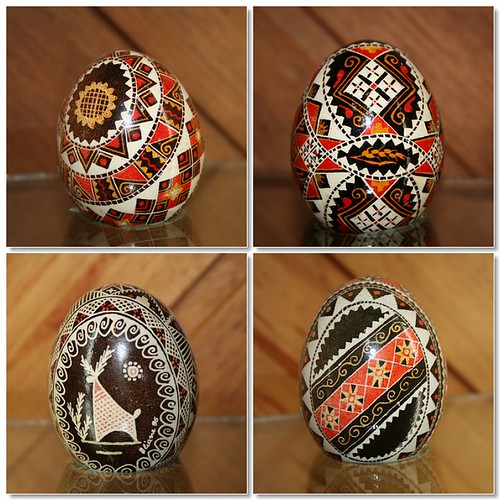
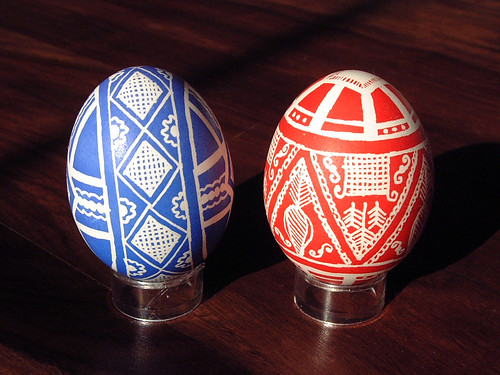
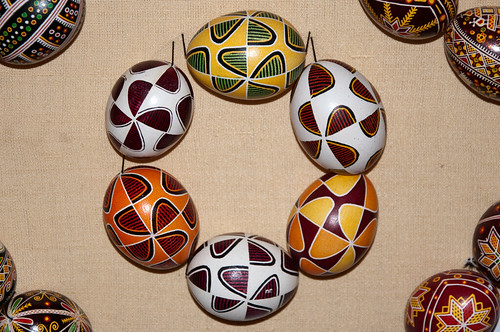
More decorated eggs in the pysanka tradition. And some more historic background. :
Pysanka [Ukrainian Easter Eggs]The art of decorating Easter eggs is one of the most interesting expressions of Ukrainian folk art. This tradition is very old and its beginnings developed in myth in which the egg was perceived as the source of life, the sun and the universe itself. Although similar myths are found in many cultures around the world, Ukrainians are one of the few peoples who strongly adhere to this ancient folklore associated with the egg.
Ukrainian Egg Painting
The Ukrainian tradition of egg decorating dates back thousands of years before Christ; when eggs were an integral part of the celebration of Spring. A variety of symbolic designs and colors were used on the eggs such as a horse (symbolic of strength) or birds (happiness) and geometric lines and circles (symbolic of eternity). With the advent of Christianity, new symbols and icons were added such as the fish.
In central and modern Ukraine, the predominant colors are red and black, whereas in the Carpathian mountains greens, orange, yellow and browns are traditionally used. White is also an important element in most traditional designs, but very difficult to preserve, and thus being lessed used. Dyes were obtained from natural sources: local plants and some inorganic substances. Nowadays, most artists use chemical dyes.
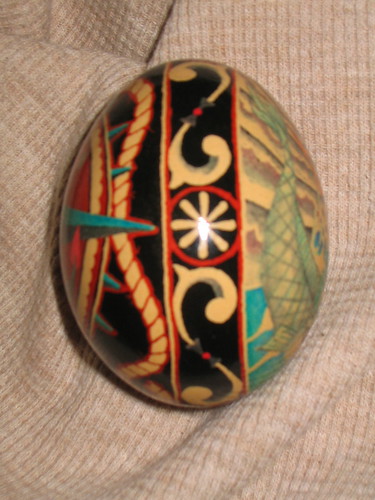
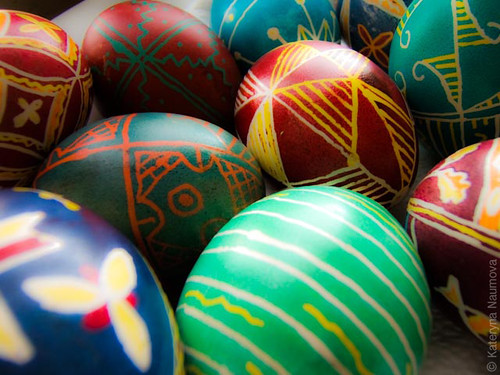
Beeswax is used to decorate the eggs and can be applied in a variety of ways. The traditional way and most skilled among egg-decorating artists is to actually "write" on the surface of the shell itself with melted beeswax using a traditional stylus tool called a "kystka" (or kistka) a kind of stylus pen, usually made of copper. Work begins by applying the pattern, working with the lightest color first (the areas designated to be white in the final design are covered in wax first). Then the egg is dipped into a dye (i.e.red) then sealed with wax. The process continues until all the desired colors have been sealed and the final color applied.If kept at room temperature, away from dust and out of direct sunlight, pysanky will keep for years and years - and eventually harden. Alternatively, the eggs can be blown, strung with coloured ribbon or string, and hung as decorations.
The egg is then held to a candle flame and, as the wax melts, it is gently rubbed off with a soft cloth. Any residue of wax is carefully removed. Finally, the egg is sealed with several layers of varnish or cold glaze.

Wednesday, September 1, 2010
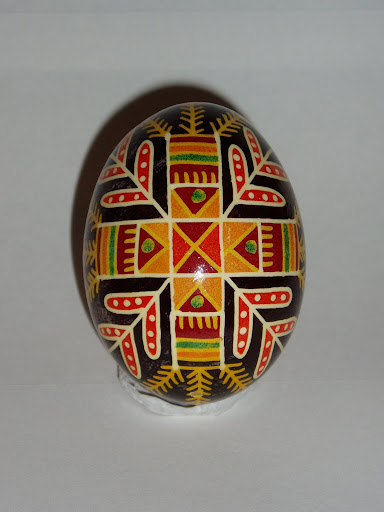
Ukrainian Eggs: Pysanka
Pysanka is an ancient Ukrainian art of decorating eggs. It has been around for over 2000 years and uses wax and pigment to decorate eggs. These ornate eggs make wonderful Christmas ornaments.






Tuesday, August 31, 2010
Encaustic Painting
Beeswax is used in encaustic art. Pigment is added to the beeswax and then it is applied to the canvas.
Thursday, August 26, 2010
Breeding Mite Resistant Bees.

Recently a British beekeeper has developed a mite resistant honeybee.
Ron Hopkins, a 79-year-old beekeeper from Swindon, discovered using a microscope that bees in one of his hives had learned how to remove the parasite from each others' bodies by grooming each other. So Mr Hopkins set about trying to spread the genes of his "grooming" bees to his other hives, using artificial insemination. It worked, and now he's hoping that it will spread via wandering queens to the rest of the bee population in Britain.Yugoslavian honeybees are know for their hygienic behavior, cleaning mites off of each other. Breeding traits into bees has been challenging since many desirable traits are not dominant and will drop out after several generations. Hygienic behavior may not be matched with traits of a bee that is hardy for winter climates or queens that lays a large and robust colony. Too many years of bee breeding with lack of genitic diversity has caused trouble. Looking to the Africanized bees migrating north from South America, they are aggressive but much more resilient to CCD and mites. Over time, breeding with native bees has made the Africanized bees a little less aggressive. Using the crucible of Mother nature with natural selection honeybees have survived for 30 million years and will continue to, but breeding traits that we deem important is much more difficult to balance a honeybee for domestic production and a honeybee bred solely for survival.
Hopkins knows that the Swindon Honeybee, as his strain has been named, is not a short-term solution. "It will take a lot of work, but it could be our only hope of saving the bee," he said today. "What I want to do is redevelop the British bee so that it can protect itself against these varroa mites. If all the bees in the world die out, then we die out. The situation is really that serious."
Friday, August 13, 2010
CCD or SNAFU?
I came across a great video from Penn State on CCD. It seems as the rate of CCD does decline in areas other causes of hive loss begin to become more apparent. Over all back in 1980 America the number of bee colonies had peaked and has been diminishing ever since. Aggravated by more intensive agricultural methods and the introduction of mites the steady decline continues even after you factor out colony collapse disorder. The current rate of winter losses is around 30% still above the more traditional 20%. This becomes more difficult to make up during the summer by splitting hives. When you have 7 of 10 of last years hives you need to be much more focused to build up your bees to get the 3 back out of the 7 left than getting a more normal 2 out of the 8 from last year. Hopefully we can get back to a more normal attrition rate sooner than later.
Monday, August 2, 2010
Beeswax Pomade
This is a popular use for beeswax. This is a straight forward low cost recipe to make your own at home. Also use the link below to find more DIY recipes for beeswax.
1 Decide what are you going to use it for what style.
2 Depending on what you will use it for will give you a general idea of the measurement of the ingredients.
3 If you want more hold give it more bees wax than petroleum jelly or oil.
4 First melt your bees wax in a clean pan until its a liquid, then pour into a cooling container.
5 Add oil or Vaseline so the wax doesn't go hard again.
6 Remember more oil or petroleum jelly: less hold, but more shine.
7 If you like, add some mint or some kind of nice-smelling oils to cover up the smell of the petroleum jelly.
Tips
1 Decide what are you going to use it for what style.
2 Depending on what you will use it for will give you a general idea of the measurement of the ingredients.
3 If you want more hold give it more bees wax than petroleum jelly or oil.
4 First melt your bees wax in a clean pan until its a liquid, then pour into a cooling container.
5 Add oil or Vaseline so the wax doesn't go hard again.
6 Remember more oil or petroleum jelly: less hold, but more shine.
7 If you like, add some mint or some kind of nice-smelling oils to cover up the smell of the petroleum jelly.
Tips
- Make it in large batches because if you're a greaser, you will use a lot.
- For it to wash out, use detergent, (like for your dishes.)
- I personally prefer to use corn starch and shampoo because it's better for your hair.
- You are handling hot wax, be careful!.
- Don't use paraffin wax or any artificial waxes instead of bees wax.
- Don't melt it in a microwave, only on a hotplate or stove.
- Never put pomade in your eyes or in your mouth.
- Keep away from kids.
- Use only cooking oils like olive or vegtable never use motor oil.
- Use only natural scented oils or edible oils for your pomade.
- a kitchen
- a pan a skillet
- a stirring spoon
- oven mitts
- a container
- bees wax
- oil or petroleum jelly
- scented oils (needed if you want it to smell good)
Subscribe to:
Posts (Atom)